The first stage of PHI Project will generate up to $9.6 billion increase in Gross State Product for Western Australia (present value, discounted at 7% pa), 1,600 jobs in construction and 400 during operations.
The Project will also generate broader opportunities for the WA economy. This includes downstream processing of iron ore, enabling hydrogen and energy projects, plus stimulating supporting services across a range of sectors.
Business relationships with potential service providers for green hydrogen, green power, gas, water, ore supply and accommodation are being developed.
The community of Port Hedland is critical to the Project. PHI will be active in earning consistent community support to sustain the workforce, amenities and activities associated with the Project.
Iron making has not been done in Western Australia for decades, so some technology and skills will need to be sourced. Our strategy is to develop a strong, local workforce which will become available, as training and upskilling programs are implemented.
The drive for emissions reduction provides Australia with an opportunity to harness the abundant natural energy of the sun and the wind and apply it to the first step of making steel – for PHI that means using high grade WA iron ore.
Australia produces around 38% of global iron ore but does very little downstream processing. There exists significant potential for the country to produce low-emission iron.
The Project, using proven MIDREX technology and supported by a pellet plant to control feed to the shaft furnace, will produce Hot Briquetted Iron (HBI; a form of direct reduced iron) as a precursor for low emissions steel production in the Asian region.
POSCO is currently developing new technology called HyREX which will enable the use of lower grade hematite ores for low carbon steel production and is keen to develop this capability in suitable locations of abundant renewable energy and iron ore resources, such as Port Hedland.
The Project will provide an opportunity for ancillary net zero economy industries like renewable hydrogen and carbon capture and storage (CCS).
Hydrogen reduction of iron ore is expected to make the largest single contribution to the net zero transition in global steel making. It is predicted that demand for hydrogen direct reduced iron (DRI) will continue to increase, as nations and industries try to reach their 2050 Net Zero targets.
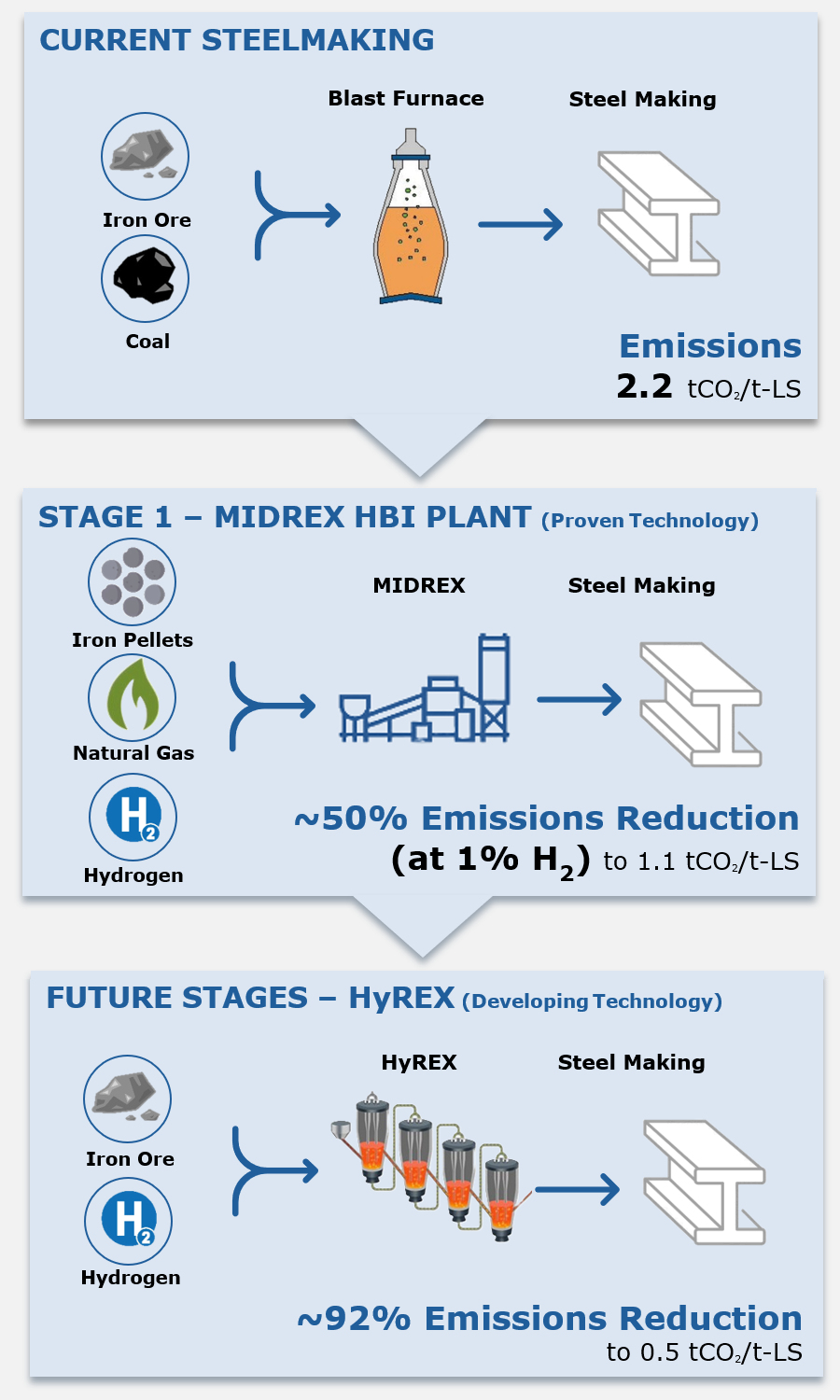
Blast Furnaces are the conventional, cheap way to make steel. They use carbon (in the form of coal) to reduce the iron (remove the oxygen from iron ore). Coal also provides the heat to melt the iron and remove impurities.
The problem with this technology is that the carbon in the coal bonds with the oxygen from the iron ore to produce the greenhouse gas CO2.
The Project will produce HBI which enables a different steel making pathway that significantly reduces the use of coal. The Project will enable an immediate reduction in emissions intensity of the steel production process by approximately 50% for every tonne of liquid steel produced.
Over the life of the Project the proportion of hydrogen introduced into the HBI process as reductant will progressively increase. The rate of hydrogen adoption will be dependent on the commercial availability and cost of hydrogen.